.svg)

It feels fitting to launch LeadHerself’s blog with an article on finding meaning as I’ve completely transformed my career in the past few years to follow a purpose I truly believe in – supporting working women, helping them step up to own their careers, inspiring courage and confidence in others. This is why I started LeadHerself.
Below I’ll share practical advice for finding meaning but first a quick intro in case we haven’t met… I’m Julianna Walsh, founder, organizational psychologist, and career coach. I earned my PhD studying and publishing research around gender and leadership, worked as a leadership consultant with global corporations, led a team at a tech startup, but not until I decided to launch my own business did I realize I had lacked meaning in my career. Find out more about my story here.
Read on if you feel like you’ve taken a backseat in your career, like you’re going through the motions but not really with any intention, waiting and hoping for a career change, waking up each day without inspiration. I was here but I didn’t know it until I was made redundant and was forced to figure out my next step. Like they say, you don’t know you’re sleeping until you wake up.
Even as a career coach, researcher, mentor, and consultant, often in the position of advising others on a range of career moves, I felt lost.
Lost in my own career.
I had to take a proper step back and figure out what I wanted to do. And the key word here is wanted. Like many others, I had started a so-called “passion project” that I’d worked on in my spare time for over a year while I was still employed full time.
As this passion project became my full-time job, things started falling into place. It felt right. My mental health improved rapidly. I went from constant anxiety and day-to-day stress to buzzing about all the things I wanted to do and people I wanted to work with. I had found meaning and I can’t even begin to describe the complete transformation I experienced.
What’s the difference between meaning and purpose?
I don’t want to get into a war of the words-that-all-mean-roughly-the-same-thing here. I’m talking about the sense of fulfillment and satisfaction you get from your work. That feeling that you’re making an impact, contributing in a meaningful way, doing stuff that really matters to you. Finding flow and joy, engaging with your work in such a way that you lose track of time. Working on something you’re passionate about, where you find opportunity and challenge.
At networking events and in coaching sessions, I’ve heard variations of a very similar story countless times. The ambitious, driven, hardworking, makes-all-the-right-choices woman in front of me had something negative – whether it be just unfortunate or absolutely devastating, a shocking incident or a gradual shift – happen in her career and it forced her to seriously question if she was on the right path, if she was doing what she really wanted to be doing, if there was something more.
There was an 80% chance she was working in tech, law, or finance – something corporate, traditional – and this change triggered a big picture perspective that we don’t often take the time to think about when we’re going about our lives. It was a wake up call that forced a change into something more meaningful by re-evaluating what matters.
Trends in meaningful work
There was a steep uptick in the Search for Meaning when covid ravished our communities and flipped the script on the way we work overnight. People started asking themselves what mattered, and had plenty of free time to reflect on the answers.
In the aftermath, many of us were still languishing, dissatisfied with work but unable to pinpoint specific causes. We may have changed jobs or adjusted to hybrid work, and still felt a sense of unease or fogginess. We may be committed to our routine, or perhaps starting to question it.
In our work life, we often try to be someone we think we should be and don’t often have the opportunity to question that assumption.
We see other people that seem to be thriving without recognizing they’re likely putting forward a professional persona. It’s no surprise that anxiety, stress, and burnout are on the rise especially with women and younger generations.
What is Ikigai and why should I care?
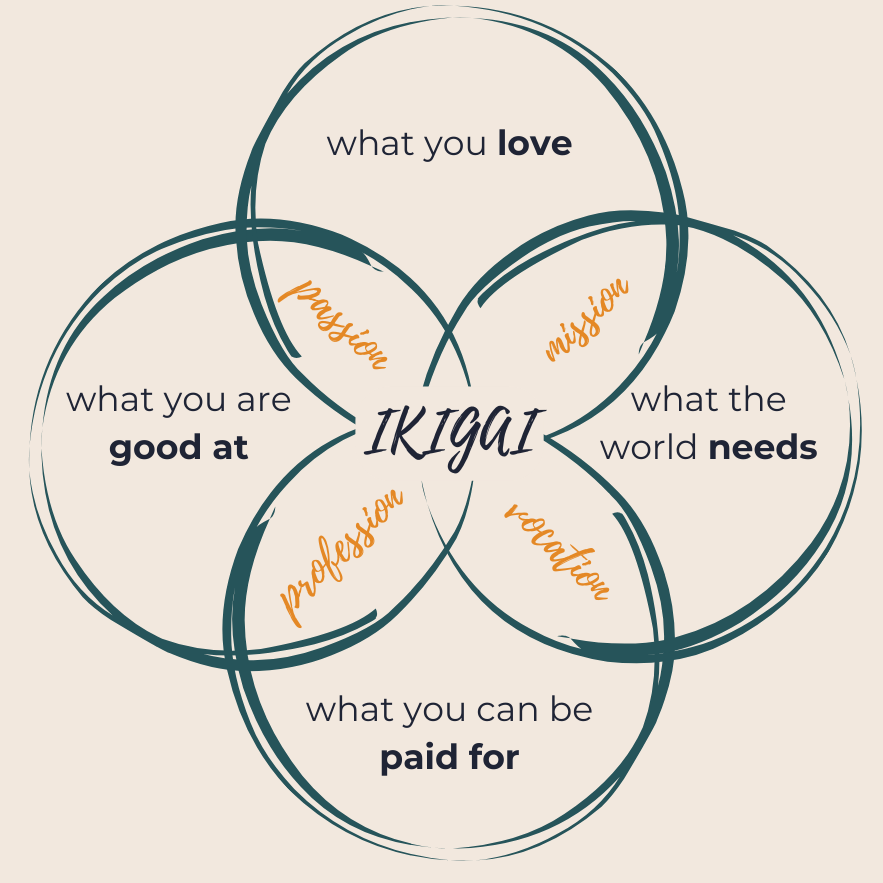
It’s a Japanese concept that roughly translated, means “reason for being.” It’s what makes your life full, joyful, blissful even. Ikigai is often represented as a diagram displaying the intersection of what you’re good at, what you love, what the world needs, and what you can be paid for.
I’m sure you can already imagine the difference between a life full of meaning versus one without, perhaps you can even feel it?
Benefits abound but some of the highlights from my personal experience and some patterns in the research suggest these are among the top 5:
- Better well-being, mental health, and life satisfaction
- Greater resilience in the face of adversity and setbacks
- Enhanced motivation to achieve and take on challenges
- Easier and stronger decision-making and strategic planning
- More effective and inspirational leadership for others
If you want to dive into this concept even further, I recently read “Ikigai: The Japanese secret to a long and happy life” by Héctor García and Francesc Miralles and I highly recommend it.
How do I know if I need more meaning in my career?
If you’re on the fence about whether this all applies to you, here are some warning signs that you might not be on the right career path…
- Feeling a gap between what you’re doing and what you’re meant to be doing
- Recognizing you aren’t or can’t be your authentic self at work
- Finding yourself experiencing FOMO when scrolling through socials
- Struggling to pay attention or concentrate throughout the work day
- Lacking motivation, inspiration, or excitement for what you’re doing
But I chose this career path, how did I end up without meaning?
Whether you’re of the mindset that work is work, it’s not meant to be fun, or you don’t have a choice, you just have bills, you may be questioning this whole concept of a meaningful career and wondering how you got here. Here are some possible explanations…
- Each decision we make from which course to take, internship to apply for, or project to take on is often made not in an objective evaluation of what will move us closer to our goals but what we feel like we should do, what we have the energy for, or what will pay off in the short-term.
- Women especially tend to fall into pleasing people and rather than make a move we see as “selfish”, we’ll do what others expect of us, what would help others or make them happy. We put caring for others above our own needs or wishes.
- We also tend to underestimate ourselves. We don’t see our strengths clearly, measure our value for what it’s truly worth, or believe we can achieve what we’re really capable of.
- Not only that but we’re often socialized to be risk averse. It isn’t that we’re scared or unable to see which risks are worth taking, it’s that as we grew up and took small risks, they might not have paid off, and we learned to play it safe.
- But I believe the biggest reason for not chasing after a meaningful career path is a fear of failure. We’re raised to be good girls, recognized for great grades, rewarded for being quiet, and taught to aim for perfectionism.
Before you get down and out feeling like the cards are stacked against you. I genuinely believe each of these points can be flipped into a positive, but I need more space to explain why and how to make that happen and I’m trying to keep this article under 2,500 words.
I share these points because the first step is being aware of forces influencing your choices, the second is to skip right past blaming yourself and start learning how to move forward.
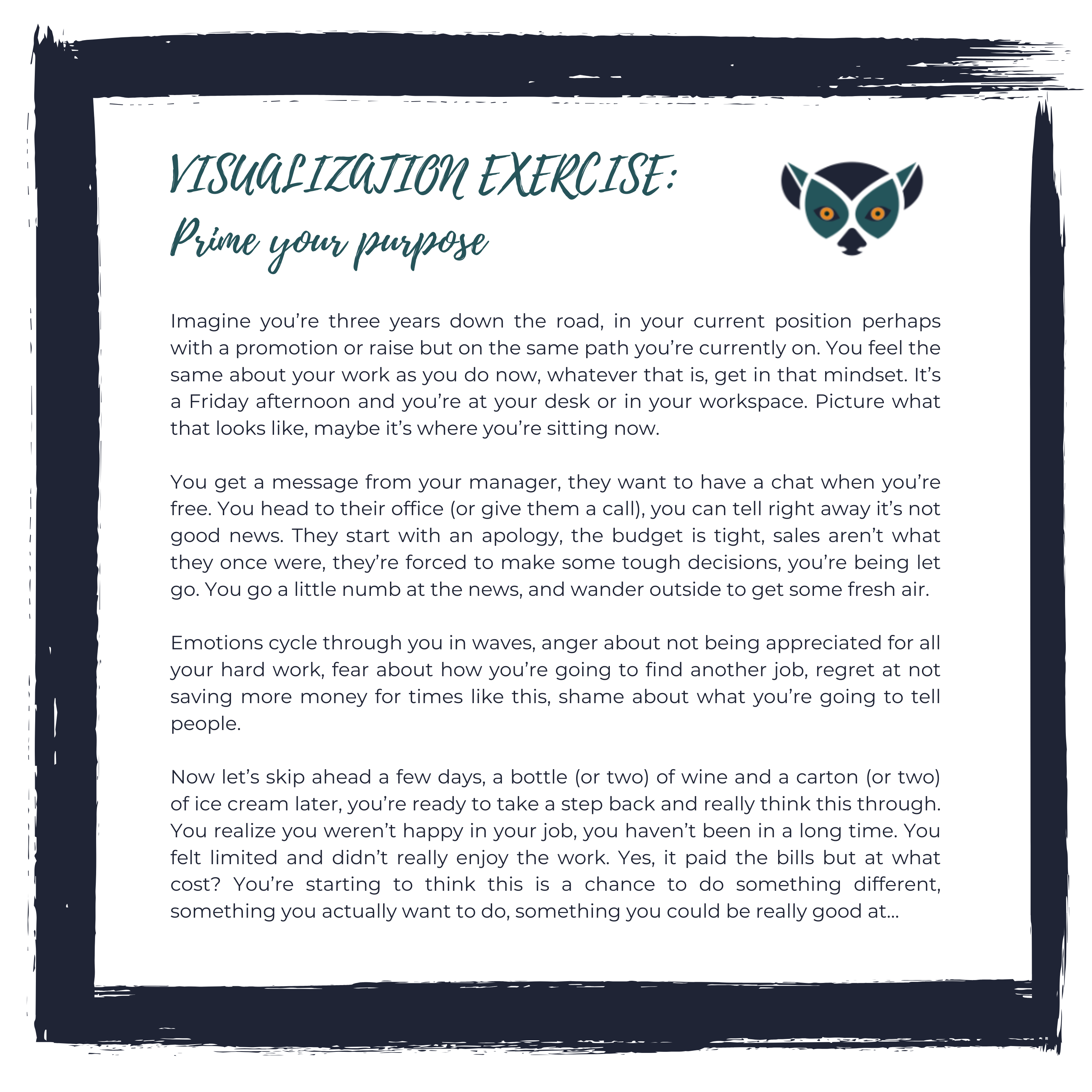
It’s not easy to be honest with yourself. We tend to identify with our jobs or industries, especially when we’re ambitious, and questioning what path is right for us can trigger a sort of identity crisis. The payoff of doing the work is priceless though. Imagine what you’re giving up on if you don’t make a change.
It’s time to evaluate where you sit in the four areas of Ikigai and figure out what matters to you so you can close any gaps. Before working through the steps, take a moment to visualize your future 10 years down the road, what are you doing? Imagine as many details as you can to flesh out this image and use it as a reference as you work through the following.

I am not telling you to quit your day job and start an Etsy shop for knitted pumpkins (unless that would bring you meaning, I support you). But, I do want to force you into a seriously deep reflection on your career before you get to a point where you need to question your career or feel like your career has just passed you by.
Ways to add more meaning into your career
There’s more than one way to make a meaningful change in your career. If you feel stuck for ideas, here are a few suggestions…
- Hobbies or volunteering: you may discover you’d like to pick up painting, playing piano, or volunteering to fill a creative or altruistic need that doesn’t entail a complete career transformation.
- Portfolio careers: activities like blogging and podcasting or part-time gigs are strong steps for exploring things that interest you, building skills, and establishing expertise without quitting your 9-to-5.
- Further education: there are loads of high quality courses out there on any topic and a lot of them are free; once you identify areas you’d like to explore, search for courses, podcasts, books, etc. to find out more.
- Job crafting: this term may not be familiar but it’s a seriously great way to add meaning to your current job by redesigning your tasks or changing a few things that would make room for more meaning.
- Freelance side hustle: this is the classic passion project approach; if you have an idea for something, start small and see what you can do in your free time before you jump in headfirst.
- Finding a new job: the most likely course of action if you’re shopping for a proper change; if it’s a far cry from what you do now, figure out how your skills translate and don’t underestimate your value.
- Starting a business: if you’ve always dreamed about running your own business and have that entrepreneurial itch; do your research to figure out your first steps and think through how it would work.
Misconceptions about meaningful work
I think it’s important at this point to level with you. We tend to have certain expectations for what a career filled with purpose will look like, and I don’t want to set you up for disappointment when reality sinks in.
- Meaningful work doesn’t require working for a non-profit. Purpose can be found anywhere.
- Finding meaningful work doesn’t require a drastic change. Hopefully I made that clear above.
- Like a soulmate, you might think you have one purpose but there are plenty of purposes in the sea (sorry).
- And like deciding to marry that soulmate, you may not be 100% sure but you’ll know if it’s worth the risk.
- Once you find your purpose, your journey doesn’t end there. What gives you meaning will change as you do.
- Meaning is found in each step on your journey to a purposeful career, not in jumping straight to the destination.
- Being really passionate about what you do can lead to burnout too, so be mindful and manage your energy.
- Hard work is still hard work but when it’s in the pursuit of a purpose you’ll have more motivation to tackle it.
- Others might not find your dreams meaningful but it doesn’t matter, let go of living up to others’ expectations.
You don’t have to love your job, you certainly shouldn’t expect to love 100% of it. The problems to avoid are leaving your potential untapped and your ambitions unrealized.
If this article strikes a chord with you, but it feels too big, too scary, too much for you right now, bookmark it and set a reminder in your calendar for a month from now to revisit the idea. I’d also be more than happy to talk you through it during a free consultation.
Remember, you are the only one who can make the choice to own your career, to discover and step into your full potential. This requires effort and action but starts with one small step.
So, what will you do to find your Ikigai?